When you’re specifying batteries for critical infrastructure, the number on the specification sheet is only part of the story. Design life is a useful starting point — but it’s not a guarantee, and it rarely tells you what you actually need to know.
Understanding the difference between design life and real-world service life helps you make better decisions upfront, manage your systems more confidently, and get more value from your investment over the long term.
What is design life?
Design life is the expected lifespan of a battery, determined through testing under controlled laboratory conditions. Manufacturers test at a stable temperature, with consistent charging and discharging behaviour, and use those results to set the figure on the specification sheet.
It’s a useful benchmark — but it describes ideal conditions, not the real world.
In practice, actual service life is shaped by where the battery operates, how well it’s maintained, how often it’s discharged, and how deeply. Get those factors right, and a battery will often outlast its rated design life. Get them wrong, and it may fall well short.
What actually determines how long a battery lasts?
Temperature
Temperature has a greater impact on battery life than most people realise. For VRLA batteries, every 8°C rise above the recommended operating temperature of 25°C can approximately halve the expected service life.
A battery rated for 10 years at 25°C may only deliver five years if it runs continuously at 33°C. For systems in plant rooms, rooftop enclosures, or remote sites with little climate control, this isn’t an edge case — it’s worth planning for from the start.
Good ventilation also matters. It stabilises temperature and prevents hydrogen gas from accumulating, which is a safety requirement for all VRLA installations.
How deeply and how often the battery is discharged
Every battery has a cycle life — the number of times it can be fully charged and discharged before its capacity drops below 80% of its original rating. How deeply you discharge the battery in each cycle has a direct effect on how many cycles you get.
For VRLA batteries, keeping the depth of discharge (DoD) to around 50% is standard practice to protect long-term life. Batteries that are routinely discharged much deeper than this will wear out faster, regardless of what the design life says.
This is why matching the right battery chemistry to your application matters so much — and it’s where the choice between AGM, gel, and lithium can make a real difference.
Maintenance
Regular, structured maintenance is the most controllable factor in getting full life from a battery system. Without it, a system that should run for a decade can fail in five years — often with very little warning.
For VRLA batteries, there’s no need to add water or check fluid levels. But the following should be recorded at least twice a year:
- Float voltage across individual blocks and the full string
- Float current
- Ambient and battery temperature
- Visual condition of the battery
- String impedance readings
- Any unusual charge or discharge events in the past six months
- Terminal connections re-torqued annually
The value of maintenance isn’t just the checks themselves — it’s the trend data. Comparing readings across visits is how you catch a problem before it becomes a failure.
Which battery is right for your application?
Valen Power offers a range of battery technologies developed over more than 20 years, each suited to different operating conditions and service life requirements. Here’s a plain-language guide to what each one does best — and what to watch for in the field.
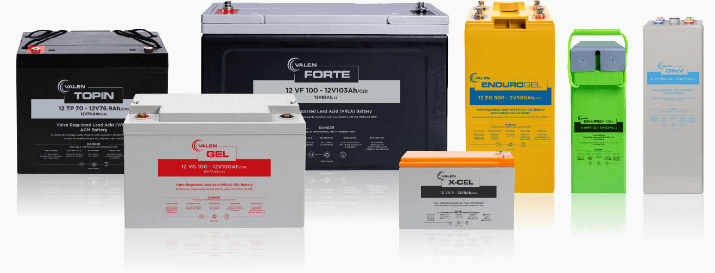
Topin is a dependable AGM battery with a 10-year standby design life. It holds CSIRO ActivFire certification and meets Australian Standard AS4029.2, making it the go-to choice for fire detection and suppression systems. It also suits diesel gensets, road signage, security, UPS, and lifts. It can be installed in any orientation except inverted — helpful where space is tight.
X-CEL is an advanced AGM battery that uses high purity virgin lead plates with a small amount of tin added to the alloy. That tin does real work: it slows down two of the most common causes of early AGM failure — sulphation (a build-up on the plates that reduces capacity) and plate delamination (plates physically breaking down over time). The result is a 10-year standby design life that holds up more consistently under sustained use. Well suited to UPS, data centres, telecommunications, hospitals, and rail.
ENVIROX-CEL Carbon is a front terminal AGM battery designed for long float life in standby environments. The plates use a calcium alloy that keeps the battery performing consistently over a 12-year design life — longer than standard AGM. Its slimline front terminal format fits directly into standard 19-inch racking, with terminals at the front for easy access during installation and maintenance. Optional external ventilation tubing is also available. A practical choice for communications infrastructure, data centres, UPS systems, rail, and mining.
ENVIROX-CELPlus+ is the highest-specification front terminal battery in the Valen Power range, with a 15-year design life. It incorporates a graphitic carbon and carbon black blend in the active material, which allows the battery to recharge faster — a meaningful advantage on sites with an unstable grid or frequent partial discharge events. The casing is both shock-resistant and flame retardant, and the battery is rated to operate in ambient temperatures up to 65°C, making it one of the most resilient options available for harsh or demanding environments. It shares the same 19-inch rack-compatible front terminal format as the ENVIROX-CEL Carbon. Suited to critical standby applications, UPS, data centres, communications, mining, rail, and solar systems where reliability under pressure is non-negotiable.
Gel uses a silica gel electrolyte rather than the glass mat found in AGM batteries. This makes it better at handling deep discharges and recovering from them — it’s more forgiving when the battery is run down heavily and repeatedly. A solid choice for cycling applications: solar systems, mobility equipment, mining, road signage, and remote telemetry. Available in 6V and 12V up to 225Ah, with a 10-year design life.
Forte is a hybrid battery that draws on both AGM and gel technology. It sits between the two in terms of performance, suited to applications that need a combination of reliable standby performance and regular cycling. If your load profile doesn’t fit neatly into one category, it’s worth a conversation with the team.
EnduroGel builds on the Gel range with a longer 15-year design life, designed for environments where uptime matters and access for maintenance or battery swap-out is limited. Available in monobloc, 2V cell, and front terminal formats. Used in telecommunications, UPS, and critical standby infrastructure.
OPzV uses a different plate design — tubular rather than flat — combined with a gel electrolyte. Tubular plates shed less active material over time, which is one of the main reasons deep cycle batteries fail early. OPzV offers the longest cycle life in the Valen Power VRLA range at 20 years, making it the right choice where deep, frequent cycling is the norm: off-grid solar, remote power, utilities, and telecommunications infrastructure that needs to run for long periods between recharges.
ENLiFEN is Valen Power’s lithium iron phosphate (LiFePO4) battery range. Lithium chemistry works differently from VRLA in ways that matter practically. The useable depth of discharge is 80% — compared to the recommended 50% for VRLA — so you get more of the rated capacity working for you in each cycle. ENLiFEN batteries are approximately three times lighter than an equivalent VRLA battery, maintain a stable output voltage almost to the end of each discharge, and are rated to operate in ambient temperatures up to 60°C.
Every ENLiFEN battery includes a Battery Management System (BMS) — an internal controller that keeps individual cells balanced during charge and discharge, and automatically protects the battery from being pushed too high or too low. The quality of that BMS is what determines how well the battery holds up over thousands of cycles.
ENLiFEN is available in monobloc and rack-mount formats. It suits applications where cycle frequency is high, weight matters, or a longer asset life is a priority — including mobility equipment, floor scrubbers, road signage, hospitals, and electric vehicles.
Looking beyond the spec sheet
| Product | Technology | Design life | What actually shapes service life |
|---|---|---|---|
| Topin | AGM | 10 years | Low-cycle standby suits it best; temperature control and consistent maintenance are the key variables |
| X-CEL | Advanced AGM | 10 years | Tin-alloy plates slow the most common AGM failure modes — more durable under sustained standby use |
| ENVIROX-CEL Carbon | Carbon AGM front terminal | 12 years | Calcium-alloy plates extend float life; front terminal format simplifies access — ideal where racking space is the constraint |
| ENVIROX-CELPlus+ | Carbon AGM front terminal | 15 years | Carbon blend improves recharge speed on unstable grids; rated to 65°C; shock and flame resistant — built for harsh, high-criticality environments |
| Gel | Gel | 10 years | Handles deep discharge better than AGM; service life extends when depth of discharge is managed |
| EnduroGel | Premium gel | 15 years | Built for longer replacement cycles; suits sites where access for maintenance or swap-out is difficult |
| OPzV | Tubular gel 2V cell | 20 years | Tubular plates last longer under frequent deep cycling — depth of discharge management still matters |
| Forte | Hybrid AGM/gel | 10 years | Suited to mixed standby and cycling profiles; talk to the team about your specific load pattern |
| ENLiFEN | Lithium (LiFePO4) | High cycle life | 80% useable DoD vs 50% for VRLA; BMS quality is critical; lighter and more stable at high temperatures |
The table above is a starting point. The right battery for your system depends on how it will actually be used — the temperature it operates in, how often and how deeply it discharges, and how consistently it will be maintained. Those three things will shape its service life more than any figure on the spec sheet.
How Valen Power can help
The systems Valen Power supports typically operate for 25 years or more. That’s a long time for operating conditions to shift, load profiles to change, and early specification decisions to play out — for better or worse.
We work alongside our clients through that full system life: from getting the chemistry right at specification, to structured maintenance support, to planning replacements well before failure becomes the driver.
If you’re working through a new specification, reviewing an ageing system, or trying to understand why a battery isn’t performing as expected — the Valen Power team is here to work through it with you.
Get in touch with the Valen Power team to discuss your battery system requirements.


