The call comes in the middle of the night. A repeater site on the GRN has gone offline. The coverage gap it has created sits right across a section of highway where emergency services were actively coordinating a response. Nobody can raise anyone on the affected channels. The on-call engineer is now awake, staring at a map, working out how long it will take to get someone to a site that is an hour and a half from the nearest town, in the dark, on a dirt road.
The cause, when they get there, is not complicated. The grid supply to the site dropped during a storm. The backup battery system, which had been in service for four years through four Queensland summers, did not deliver what it was supposed to. The repeater shut down. The coverage disappeared.
It is a failure mode that communications infrastructure managers across government radio networks, public safety networks and wireless internet service providers know well. And it is one that is almost entirely preventable.
Why grid-tied repeater sites are a reliability problem waiting to happen
Most GRN and PSN repeater sites were established with a straightforward power design: mains supply as the primary source, a battery backup system to ride out short outages, and in some cases a generator for extended events. That design made sense when it was specified. It makes less sense now, for a few compounding reasons.
The grid supply to remote repeater sites is often the least reliable part of the electricity network. Sites on the end of long rural feeders, on ridge lines chosen for RF propagation rather than infrastructure convenience, or in areas regularly affected by bushfire and storm damage, see more outages and more voltage events than the network average. The battery backup system that was designed to handle occasional brief interruptions is working much harder than the original specification assumed.
Lead-acid batteries, which still dominate backup power in communications infrastructure, degrade in heat. A battery cabinet on an exposed hilltop in summer reaches temperatures that accelerate capacity loss significantly. The battery that tested at acceptable capacity during a mild month may be well below usable performance by February. The system that looks fine on paper fails when it matters most, because the conditions that cause grid outages, storms, extreme heat, bushfire, are the same conditions that stress a degraded battery beyond its actual remaining capacity.
And because most repeater sites are unmanned and remotely monitored at a fairly basic level, the degradation is invisible until it causes a failure. The battery that is silently losing capacity between annual inspections does not raise an alarm. It just stops working when the grid goes down.
What the ModX2 changes about this
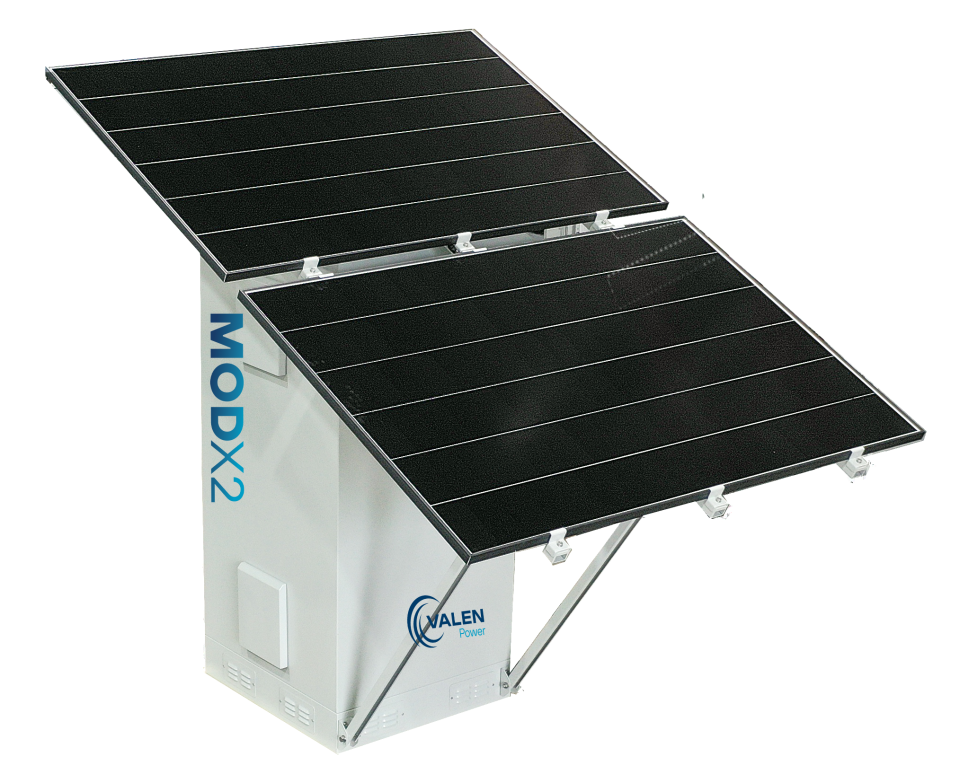
The Valen ModX2 is a pre-wired, pre-tested off-grid solar power system built around LiFePO4 battery chemistry and Victron Energy components. It is designed for exactly the kind of application that remote GRN and PSN repeater sites represent: a critical load in a remote location that needs reliable, continuous power without depending on the grid or on someone driving out to refuel a generator.
The system ships with 990 Wp of solar PV and 10.6 kWh of LiFePO4 battery storage. All components are factory-wired and tested as a complete system before dispatch. Field installation involves connecting the batteries and plugging in the solar panels. The solar panels install at ground level. There are no elevated work platforms, no specialist commissioning requirements, no compatibility questions between components that were sourced separately. A competent field technician can have the system operational in a standard site visit.
For a communications infrastructure team managing a portfolio of repeater sites, that installation simplicity matters beyond just the first deployment. It means the same team that maintains the radio equipment can install and commission the power system without bringing in specialist contractors. That reduces the cost and the scheduling complexity of upgrading power across a network of sites.
LiFePO4 chemistry is the core reason the ModX2 performs differently from a conventional lead-acid backup in a GRN application. It holds capacity far better across operating temperature ranges, tolerates deeper and more frequent cycling without the accelerated degradation that shortens lead-acid service life in hot environments, and has a cycle life measured in thousands rather than hundreds of cycles. The battery that is still in a remote communications cabinet five years after installation is performing closer to its original specification than a lead-acid replacement would be.
Victron VRM monitoring and what it means for network visibility

The ModX2 uses Victron Energy components throughout, with a Cerbo GX controller that connects to the Victron VRM cloud monitoring platform. That gives the network operations centre real-time visibility of every monitored site: battery state of charge, solar generation, load draw, system health and alarms.
For a GRN or PSN operator managing sites across a large geographic area, that visibility changes the maintenance model entirely. Instead of learning about a power problem when the repeater goes offline and the coverage gap appears, the operations team sees a battery trending below expected performance weeks before it becomes an issue. Maintenance gets dispatched proactively, based on what the system is actually doing, not on a calendar schedule that has no idea what the site has been through since the last visit.
It also changes the economics of managing a large site portfolio. Scheduled site visits that find nothing wrong are expensive. Condition-based maintenance, where crews go to sites that the monitoring data says need attention, concentrates resources where they are actually needed. Across a network of 30 or 50 repeater sites, that change in approach reduces total maintenance cost materially.
The Victron VRM platform also supports 4G connectivity at sites without fixed-line data, which covers the majority of remote GRN and PSN locations. The monitoring connection works wherever there is mobile coverage, and for sites beyond mobile coverage, satellite connectivity options exist.
Sizing a ModX2 for a repeater application
Repeater sites vary in their load profile. A simple passive repeater draws less than an active site with controller hardware, HVAC, and auxiliary equipment. The autonomy requirement, meaning how many consecutive days of low solar input the system needs to carry the load without generator backup, depends on the location, the site’s criticality and the network’s operational requirements.
The ModX2 configurator on the Valen website captures the key inputs that determine whether the standard ModX2 configuration suits a specific site, or whether a different arrangement is needed. It takes a few minutes to complete, and a member of the Valen engineering team comes back with a properly sized recommendation based on the actual site parameters.
That conversation is more valuable than working backwards from a spec sheet, particularly for sites where the load has grown since the original power system was designed, or where the required autonomy is more demanding than a standard backup battery arrangement was built to handle.
The 2am call that does not happen
The GRN repeater that stays online during a storm outage because it is running on a properly specified off-grid solar system does not generate a call. The operations centre sees the grid supply drop on the monitoring dashboard. It sees the ModX2 carrying the load on battery. It sees the solar generation pick up the next morning. Nobody drives anywhere. Nobody makes a 2am call to an on-call engineer. The site does its job.
That is what reliable communications infrastructure power looks like. It is quiet, continuous and unremarkable, which is exactly how it should be.
Use the ModX2 configurator to size a system for your repeater sites.


