Critical UPS Infrastructure
UPS Replacement Batteries: Lithium UPS Battery and High-Temp UPS Options
Data centres, hospitals, banks, government and comms rooms rely on UPS batteries ready the moment power goes unstable. For service companies, distributors and contractors, battery reliability is your service contract, your callout rate and your customer’s trust. Valen supplies the right batteries and testing gear for critical power, backed by people who understand it.Â
Trusted by UPS integrators, including an 80-battery front-terminal bank supplied for Crown Casino, Melbourne.Â
A recurring requirement
Recurring, time-pressured, and unforgiving
UPS battery replacement is a recurring requirement across critical infrastructure. When a bank reaches end of life, fails testing or underperforms during maintenance, service teams need products that are reliable, available and supported by people who know critical backup. Valen helps service companies, distributors, contractors and end users source the right batteries and testing equipment for environments where downtime is not acceptable.Â
Reliable supply, better maintenance support, products for critical sites
Reliable battery replacement supply
Service teams need batteries they can trust across recurring maintenance, planned refresh programs and urgent replacements. Valen supplies battery options for UPS and standby applications, including AGM, VRLA, front terminal and monobloc solutions.
Better support for service and maintenance
UPS providers often work to tight maintenance windows. Valen supports smoother replacement planning with practical product advice, battery testing equipment and component supply.
Products for critical environments
From data centres and hospitals to banks, government facilities and communications rooms, Valen supports UPS applications where battery failure can create serious operational risk.
UPS applications we support
Battery supply matched to the site it protects
-
Data centres and server rooms
Battery and UPS support for enterprise data centres, server rooms, ICT infrastructure, network rooms and managed service environments.
-
Banks and financial infrastructure
UPS batteries and testing equipment for banking, financial services, secure facilities, ATMs, data rooms and compliance-driven infrastructure.
-
Commercial and industrial sites
UPS battery supply and backup power components for commercial buildings, industrial facilities, switchboards, automation systems and control equipment.
-
Hospitals and healthcare
UPS battery replacement and testing support for healthcare environments where backup power protects critical systems, equipment and continuity.
-
Government and defence facilities
Battery replacement, UPS support and testing equipment for government buildings, secure facilities, emergency services and critical operations.
-
Service and maintenance programs
Battery supply, testing equipment and replacement support for service companies managing recurring UPS maintenance contracts.
Frequently Asked Questions
How long do UPS batteries last, and how often should they be replaced?
Design life and service life are different numbers and the gap is mostly temperature. A EUROBAT Long Life class VRLA is classified at 10–12 years on float at 20 °C; in a plant room running at 30 °C that becomes roughly five years, and at 40 °C roughly 2.5. Australian field policy for comparison: AusNet uses 12 years typical while capacity stays above 80%; Powerlink uses 12 years for 2 V cells and 8 years for 12 V monoblocs. For a monobloc UPS string in an uncontrolled room, planning on 4–6 years is more realistic than planning on the design life.
Why does my UPS only give a few minutes of runtime?
Three causes, in order of likelihood. The battery has lost capacity, end of life is conventionally 80% of rated, and a bank at 60% delivers a fraction of its original runtime. The load has grown since the bank was specified, which is extremely common in a room that has had equipment added over a decade. A single weak battery in the string is dropping the whole string to its end voltage early, in a series string, capacity is set by the weakest member. The diagnostic order is: measure the actual load, then test the string, then test individual units.
What are the signs a UPS battery is failing?
Runtime shorter than expected on test or on a real event; individual monobloc voltages diverging from the string average; rising internal impedance against the baseline taken at installation; case swelling, terminal corrosion, cracking or any sign of electrolyte leakage; and a battery noticeably warmer than its neighbours. The last of these deserves urgency rather than a note in the log, a hot battery on float is a thermal runaway precursor, and AusNet lists thermal runaway from excessive charging among the failure modes observed across its fleet.
Can I replace only some of the batteries in a UPS string?
Front terminal Q7.9. Within the first year, replacing a single failed unit is reasonable. After roughly a third of design life it is a false economy, the new battery is dragged toward the condition of the old ones and string capacity is still set by the weakest member. Never mix chemistries or design-life classes in a string.
Should I move from VRLA to lithium in my UPS?
SOLiCORE Q8.14. Consider it seriously where weight or floor loading is a constraint, where footprint limits achievable runtime, or where the room runs hot enough that VRLA life is uneconomic. Be more cautious where the duty is pure standby in a controlled room, where the UPS manufacturer will not support third-party lithium, and in New South Wales, where the building fire engineering path for lithium is now materially more demanding. See U6.
What are the fire and compliance implications of lithium in a data centre or building UPS?
This changed materially in 2026 and any current project should assume scrutiny. Reported in June 2026: Fire and Rescue NSW requires lithium-ion battery storage rooms in data centres to achieve a Fire Resistance Level of 240/240/240 for load-bearing elements, does not support reductions, and aligns sprinkler recommendations with NFPA 855:2026 for energy storage exceeding 50 kWh, a threshold that captures essentially every data centre lithium UPS. FRNSW’s reasoning is worth noting: cell- and module-level UL 9540A results “do not in isolation represent the credible fire scenario” for an enclosed compartment. FRNSW is not banning lithium; it is refusing a reduced fire-engineering standard for it. Also note that AS/NZS 5139 does not apply to UPS complying with AS 62040, the governing references are AS 62040, AS 3011 and AS 2676.
Systems
Explore all Valen systems
Protection from blackouts, interruptions and unstable supply for critical electronics, communications rooms, medical environments and data centres.

Integrated energy systems for remote, critical and high-dependency infrastructure beyond UPS backup.
Components
Explore all components
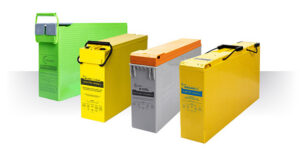
For UPS cabinets, standby systems and critical backup where accessible installation, replacement and maintenance matter.

Reliable sealed lead acid performance for UPS, communications, automation and standby applications.

High-quality AGM battery performance for UPS, communications and automation applications.

Dependable AGM batteries for service teams across standby and backup power applications.

For established UPS replacement programs, standby systems and critical backup environments.

For testing UPS batteries, standby banks and critical battery systems during maintenance inspections.

Test UPS and critical battery systems without disconnecting batteries from service.

Reliable charging across standby, UPS and industrial backup applications.
Match the products to the job
Battery replacement programs
Dependable products for scheduled replacement, maintenance contracts and urgent callouts.
Testing & maintenance
Check battery health during planned maintenance without unnecessary disruption.
Critical backup protection
Protect infrastructure from interruptions, blackouts and unstable supply.
Built around uptime and the realities of recurring maintenance
Built around uptime
UPS batteries sit behind critical infrastructure. Product selection considers runtime, replacement cycle, load profile, site access and the cost of failure.
Practical for recurring maintenance
Replacement is not a one-off purchase. Valen supports battery options, testers and components that fit repeat maintenance workflows.
Support across critical sectors
UPS requirements across data centres, healthcare, banking, government, commercial, industrial and communications infrastructure.
Components that keep work moving
From front terminal batteries and monoblocs to testers, chargers and UPS systems, the core products to keep backup ready.
Servicing Clients Australia and New Zealand Wide
Valen Power partners with industry leaders across diverse sectors providing innovative energy storage solutions and unparalleled support to meet their unique needs.
Valen Resource Centre
The most comprehensive library of information about industrial batteries and energy storage anywhere.