As off-grid and hybrid power solutions continue to evolve, one key question remains for engineers and operators: should you invest in a towable or skid-based hybrid power system? Both options deliver off-grid energy, but their design and deployment differ in ways that affect efficiency, cost, and reliability.
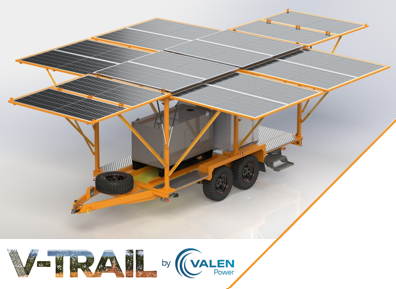
At Valen Power, we’ve engineered the V-Trail Deployable Stand-Alone Power System (SAPS) to combine superior mobility, fast deployment, and advanced safety while being proudly built in Australia.
Deployment and Mobility
A towable system like the V-Trail is purpose-built for rapid deployment. It can be transported using standard vehicles and set up by a single operator in under thirty minutes. The assisted gas-strut design allows quick and safe deployment of its 8.6 kilowatt solar array without extra tools or manpower. This makes it ideal for rapid response, remote projects, or temporary operations that require easy relocation.
Skid-based systems, on the other hand, require cranes or heavy machinery for repositioning. They also may require costly groundwork. This increases cost, time, and risk, especially for operations that move often or operate in challenging terrain.
Towable systems clearly offer an advantage when it comes to ease of transport and deployment speed.

Terrain Adaptability and Durability
The V-Trail is mounted on a 3500 kilogram trailer engineered for off-road use. Its independent suspension, compact length, and low center of gravity provide excellent stability on rough tracks. Optimized departure angles protect solar panels during transit, while the integrated fuel tank adds balance and safety.
Skid-based systems perform well on levelled surfaces but struggle on uneven or soft terrain. They are difficult to move once placed and are better suited for long-term stationary applications.
Towable systems provide greater flexibility and resilience in varied environments.
Setup and Operation
The V-Trail connects easily through a standard 63 amp plug or hardwire configuration. The 43 kilowatt-hour lithium battery bank and 8.6 kilowatt solar array deliver continuous renewable power. The entire setup can be completed quickly by one person, saving both time and labor.
In contrast, skid setups are more complex and require multiple workers and lifting equipment. They are better for fixed installations that do not need to be moved frequently.
For simplicity and efficiency, towable systems outperform skid designs.

Energy Efficiency and Fuel Management
Valen’s V-Trail minimizes diesel consumption while maximizing renewable generation. Under optimal sunlight, it can operate entirely on solar and battery power. The 36 kilovolt-amp generator activates only when battery levels reach ninety-two percent depth of discharge, extending runtime and reducing fuel dependency. Its one hundred litre bunded tank and auxiliary fuel port make refueling simple and safe.
Most skid units rely more heavily on generators due to limited solar capacity, leading to higher operational costs and maintenance.
Towable systems like the V-Trail are more sustainable and fuel-efficient.
Safety and Reliability
V-Trail is engineered with advanced safety and protection features. Its high fault-current inverter trips 63 amp breakers quickly to prevent arc faults and damage. The lithium iron phosphate battery chemistry provides stable, fire-resistant operation. Noise-reducing housing keeps generator sound levels low, making it suitable for sensitive sites such as telecommunications towers and remote communities.
Skid-based systems may rely on heavier lead-acid batteries and simpler inverter protection, making them less efficient and louder during operation.
Towable systems deliver a safer, quieter, and more reliable experience.
Monitoring and Maintenance
The V-Trail includes remote monitoring that allows operators to track solar generation, battery levels, and generator activity in real time. This reduces site visits and enables predictive maintenance.
Skid-based systems usually depend on manual inspection, which increases downtime and maintenance costs.
Towable systems simplify oversight and improve long-term reliability.
Local Manufacturing and Support
The V-Trail is manufactured and assembled in New South Wales. Local production ensures parts availability, faster servicing, and compliance with Australian registration standards. Supporting local manufacturing also strengthens after-sales support and reduces downtime.
Many skid systems are imported or built with international components, which can delay service and increase costs.
Locally built towable systems provide faster response times and stronger support.
The V-Trail Trailer-Mounted Stand-Alone Power System redefines hybrid energy mobility in Australia. Built for real-world conditions, it offers quick setup, off-road stability, and high renewable integration. Compared to skid-based systems, it delivers greater flexibility, safety, and long-term value.
V-Trail is the smarter choice for industries that depend on continuous off-grid power, including telecommunications, defense, mining, utilities, and emergency response operations.
To learn more, visit valen.com.au/v-trail or contact the Valen Power team to find out how the V-Trail can power your next project.


