Home / Component Range / Lithium Batteries / Valen SOLiCORE Solid State Lithium Batteries / Valen SOLiCORE 48V 100Ah Solid State Lithium Battery
Valen SOLiCORE 48V 100Ah Solid State Lithium Battery
SKU: 48ELSS100
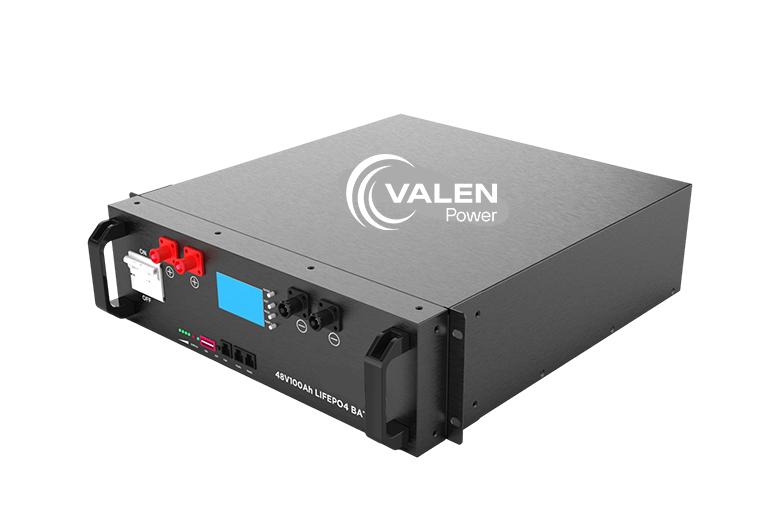
Valen SOLiCORE 48V 100Ah semi-solid state LiFePO4 rack mount battery for telecoms, critical infrastructure and off-grid energy storage.
SOLiCORE is a next‑generation 48V 100Ah semi-solid state LiFePO₄ battery engineered for high‑performance energy storage across commercial, industrial, and off‑grid applications. Using a solid electrolyte instead of traditional liquid chemistry, it delivers superior safety, stability, and efficiency, with improved performance in both high and low temperatures. The module offers long service life with more than 5000 cycles at 100% DOD and up to 10,000 cycles at 80% DOD, making it a robust, low‑maintenance solution for long‑term energy systems. Its modular 3U design integrates easily into 19” racks, supports up to 16 units in parallel, and includes built‑in BMS protection and LCD monitoring for reliable, scalable operation.
Price
+GST
Qty
Features
- Semi-Solid State Safety: a composite polymer electrolyte with substantially reduced free liquid electrolyte, delivering higher thermal stability and improved abuse tolerance compared with a conventional lithium cell.
- Long Cycle Life: 5000 cycles at 100% DOD and 10,000 cycles at 80% DOD.
- Extreme Temperature Performance: Over 97% discharge capacity even at −20°C.
- High Power Capability: 100A continuous discharge with 250A peak (2s).
- Smart BMS + Monitoring: Integrated protection plus RS485, CAN and LCD display.
- Modular Scalability: Up to 16 units in parallel, reaching large‑capacity systems.
- Rugged Build: IP54 metal case, low temperature rise, and 3U rack‑mount form factor.
- Certified to IEC 62619, UN 38.3 and UL 1973, and tested to UL 9540A.
Applications
Critical Infrastructure, Telecommunications
Specifications
| Voltage | 48 V |
|---|---|
| SKU | 48ELSS100 |
| Length | 517 mm |
| Width | 442 mm |
| Height | 133.5 mm |
| Capacity | 100 |
Downloads
Related Products
Frequently Asked Questions
Will SOLiCORE communicate with my inverter or rectifier?
SOLiCORE provides two RS485 ports and one CAN port, plus a local LCD display. Closed-loop support is confirmed on request, send us your inverter or rectifier make, model and firmware version and we will confirm before you order.
We answer it that way deliberately, rather than claiming universal compatibility, because the same physical interface does not guarantee compatibility. RS485 and CAN are transport layers. For closed-loop operation, the baud rate, message identifiers, register map, protocol version and firmware version all have to align between battery and power conversion equipment. “It has CAN, your inverter has CAN, so it will work” is a claim that fails at commissioning, and the cost of discovering that on site is considerably higher than the cost of asking first.
Closed loop versus open loop, and why it matters:
Closed loop, the battery management system reports state of charge, state of health, charge and discharge current limits, voltage, current, cell and pack temperature, alarm codes and protection status, and the inverter or rectifier adapts its behaviour in real time. You get accurate state of charge, coordinated protection, and charge control that respects the battery’s actual condition.
Open loop, fixed voltage and current settings entered manually, no feedback. State of charge display becomes unreliable, protection coordination is limited to voltage thresholds, and the charger cannot know when the battery is derating itself.
For an industrial installation, specify closed loop and verify it at factory acceptance test rather than on site.
What warranty comes with SOLiCORE?
Five years, with rated cycle life of 5,000 cycles at 100% depth of discharge and 10,000 cycles at 80% depth of discharge.
The conditions matter more than the headline period on any lithium warranty, and these are the ones to read:
- Temperature ranges. Charging is permitted from 0 °C to 55 °C, discharge from −20 °C to 60 °C, and storage from −20 °C to 45 °C. Operating or storing the battery outside those ranges is the most common reason a lithium claim is declined, particularly charging below 0 °C, which causes cumulative, irreversible damage.
- Depth of discharge and the 40 V cut-off, and whether your plant’s low-voltage disconnect is coordinated with it.
- State-of-charge storage conditions. LiFePO₄ held at 100% state of charge for extended periods ages faster.
- Battery management system firmware currency.
- Charge voltage within the 56.8–58.4 V window. A charger set for lead-acid float is outside it.
- Freight and labour on a warranty replacement to a remote site, often the largest cost in the event.
The most useful thing to do at commissioning is start the evidence file: commissioning readings, firmware version, charge settings and the monitoring configuration. It takes an hour and it is what a claim rests on.
How do I get pricing for SOLiCORE?
Trade and project pricing is available through the Valen webstore once you are logged in to your account. If you do not have an account, contact us on 1300 734 253 and we will set one up.
We are deliberately not competing on the retail price of a 48 V 100 Ah module, and it is worth being clear why, because it affects whether this product is right for you. There is a large Australian retail market in 48 V rack batteries serving off-grid homes, caravans and small solar installations, and it is priced accordingly. SOLiCORE is built for a different job:
- 3U industrial form factor that fits a comms or DC power cabinet
- IP54 construction
- Two RS485 ports and CAN for integration into a real power system
- Certification to IEC 62619, UN 38.3 and UL 1973
- Documentation and support at the level a telco, network operator, rail authority or road authority needs to specify it into an asset they maintain for a decade
If the application is a shed or a caravan, there are better-value options on the market. If you are replacing a battery bank at a site where a failure means an outage, a callout and a report, the relevant comparison is not the module price. It is the ten-year cost including replacements, site visits, integration and the risk of a bank you cannot see inside.
How do I ship or transport lithium batteries in Australia?
Lithium batteries are dangerous goods. They move under UN 3480 (lithium ion batteries) or UN 3481 (contained in or packed with equipment), Class 9, and every cell or battery must be of a type proved to meet the tests in the UN Manual of Tests and Criteria, Part III, sub-section 38.3 before transport in Australia. SOLiCORE is certified to UN 38.3.
For a working, correctly packaged battery from a compliant supplier, this is routine and handled by the freight arrangement. The two situations that catch people out are worth planning for in advance:
Damaged or defective batteries must be marked “DAMAGED/DEFECTIVE LITHIUM-ION BATTERIES” and packed to specific packing instructions. Not every carrier will take them.
Batteries for disposal or recycling travel under a dedicated provision, marked “LITHIUM BATTERIES FOR DISPOSAL” or “LITHIUM BATTERIES FOR RECYCLING”.
The practical implication for remote-site work: the removal is harder than the installation. A failed lithium bank at a site three hours from a highway needs compliant packaging, correct marking and a carrier willing to take Class 9 damaged goods. Lead-acid has no equivalent burden. Build the end-of-life logistics into the project at the start, and ask your supplier whether they manage the removal or leave it with you.
What is the total cost of ownership compared with VRLA?
It depends almost entirely on whether the battery cycles, and most published comparisons are unreliable because they compare a lithium design life against a VRLA field life. Here is the honest structure.
Where lithium wins clearly, cycling duty. On a daily cycle, VRLA delivers hundreds of cycles and lithium delivers thousands. Over fifteen years a cycling VRLA installation may be replaced three or four times, and on a remote site each replacement is a site visit, freight, labour, decommissioning and disposal, usually several times the cost of the battery itself. Lithium’s higher purchase price is recovered on the second replacement it avoids.
Where lithium wins on secondary factors, hot and space-constrained sites. Lithium’s usable depth of discharge is 80–95% against 30–50% design practice for cycling lead-acid, so you buy roughly half the nameplate capacity for the same usable energy. It is materially lighter and smaller, which matters where floor loading, rack space or cabinet volume is the binding constraint. And it does not follow the VRLA temperature-life curve, so hot sites do not consume it.
Where the picture is much less clear, pure standby duty in a controlled room. A UPS battery cycling a dozen times in its life will be replaced on calendar ageing, not cycles. Lithium’s cycle advantage is worth nothing there. What remains is footprint, weight and temperature tolerance against a higher capital cost, a battery management system in the protection path, and in New South Wales as of 2026, a materially more demanding fire engineering path in a building. Reasonable engineers reach different conclusions on those trade-offs. We will work through yours with you rather than apply a default.
What to include in your own model: purchase price, installation labour, the number of replacements over the asset horizon, replacement labour and freight to your actual site, decommissioning and disposal cost, monitoring cost, cooling energy, floor space, and any fire engineering or room upgrade the chemistry triggers. Leave any of those out and the answer changes.
Can lithium batteries be used in an outdoor telecom or roadside cabinet in Australia?
es, and lithium is often the better choice, but the cabinet’s thermal design, not the battery’s datasheet, decides whether it works.
VRLA loses roughly half its life expectancy for every 10 °C of sustained temperature above 20 °C, which is why a long-design-life VRLA becomes a short-lived consumable in a sun-loaded enclosure. LiFePO₄ does not degrade on that curve. In a 40 °C-plus cabinet, lithium’s whole-of-life cost advantage is at its largest, and it is the reason Australian road authorities have increasingly specified LiFePO₄ for roadside critical infrastructure.
Three things must be right:
- A maximum internal temperature. Industry standards require cabinets to hold internal temperature no higher than 50 °C, achieved with double-skinned construction, ventilation slots, thermostatically controlled fans, and white heat-reflective paint. SOLiCORE’s discharge range extends to 60 °C, but charging stops at 55 °C.
- A minimum internal temperature. Standards also require a minimum of 0 °C with a thermostatically controlled heater. This prevents charge inhibition at sub-zero temperatures and maintains battery responsiveness in alpine and high-altitude regions.
- A charge regime the BMS accepts, and coordination between the BMS cut-off and any plant-level low-voltage disconnect.
For any lithium installation inside an occupied structure, assume the fire engineering will be examined. Plan accordingly.