A Technical Review of Deployable Hybrid Power for Remote and Off-Grid Operations
Mining operations depend on continuous power to maintain productivity and safety. A single interruption can halt production lines, disable water pumping or communication links, and expose workers to unnecessary risk. Yet many mines, particularly exploration and satellite sites, operate far beyond grid reach. Extending transmission infrastructure is often uneconomic or impossible during early development phases.
To keep operations running, most mining companies rely on diesel generator fleets. These systems are proven but expensive to maintain. They consume large volumes of fuel, require frequent refuelling runs, and are vulnerable to mechanical breakdown. The need for low-touch, transportable, and cleaner energy solutions has driven the mining industry to explore hybrid stand-alone power systems (SAPS).
This paper examines the Valen Power V-Trail Towable Hybrid SAPS from a technical perspective to determine whether its architecture, output, and operating logic meet the environmental and operational demands of mining applications.
Power Demands in Mining
Mining sites are unique environments. They are exposed to dust, vibration, high temperatures, and uneven terrain. Some sites run 24-hour production while others operate intermittently, such as exploration camps that relocate with each drilling phase. Power requirements vary widely, from small monitoring systems to large process plants.
Permanent mine infrastructure usually draws hundreds of kilowatts or even megawatts. Those heavy loads are beyond the scope of a trailer-based SAPS. The V-Trail, however, targets the smaller but critical category of auxiliary and remote loads that keep operations functional. These include communications shelters, water and chemical dosing pumps, telemetry stations, lighting towers, and safety systems.
Because these loads are essential yet often spread across wide areas, they benefit most from a power unit that can work independently and move easily from one location to another.
Overview of the V-Trail System
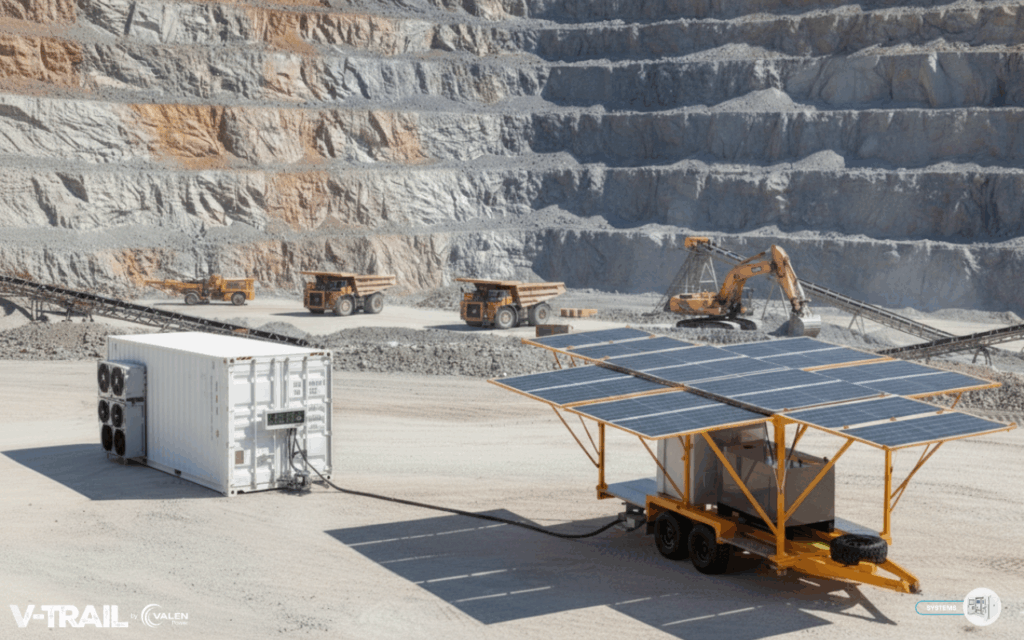
The V-Trail integrates renewable generation, battery storage, inverter control, and a generator within a single towable platform. It can be deployed by one operator in under an hour, providing immediate off-grid power without construction work.
Solar generation: The trailer carries a 8.6 kilowatt photovoltaic array that folds for transport and unfolds using a gas-strut system. The maximum charge input of 35 kilowatts allows optional solar mats or skids to be added when extended operation is required.
Battery storage: Energy is stored in a 43-kilowatt-hour lithium iron phosphate (LiFePO₄) battery bank made up of nine 4.8-kilowatt-hour modules. This chemistry offers excellent thermal stability, long cycle life, and predictable voltage behaviour under heavy loads.
Inverter system: Two low-frequency transformer-based inverter-chargers provide 30 kilovolt-amperes of peak power and 26 kilowatts continuous. The dual configuration ensures redundancy and stable operation under inductive load.
Generator: A 36-kVA diesel generator using a Yanmar engine supports the hybrid system. It starts automatically when battery depth of discharge approaches 92 percent and stops once recharge is complete. The generator is lightweight, corrosion-resistant, and easy to service in the field.
Fuel storage: The standard 100-litre bunded tank meets environmental standards and can connect to an auxiliary fuel pod for longer runtime.
Engineering Characteristics That Matter to Mining
Mobility and Fast Deployment
Mobility is critical in exploration and temporary setups. The V-Trail can be towed to new drill sites or satellite camps and brought online within minutes. No cranes, footings, or heavy equipment are needed. This flexibility reduces delays between phases and lowers mobilisation costs.
Durability and Safety
The system is built for industrial conditions. Galvanised and aluminium components resist corrosion, while reinforced wiring looms and vibration mounts protect electrical integrity. All live equipment sits inside lockable ventilated compartments that comply with Australian safety regulations.
Energy Efficiency
The V-Trail operates primarily on solar and stored energy. Generator use is secondary, which reduces fuel consumption, emissions, and acoustic impact. In idle periods when load demand is low, the inverter’s parasitic draw is only about 120 watts for the pair, helping to conserve stored energy.
Maintenance Simplicity
Mining logistics often involve long distances between service hubs. A system that can run for extended periods without hands-on maintenance is valuable. Because the V-Trail’s generator runs infrequently, wear and oil contamination are minimal, extending service intervals.
Electrical Performance and Integration
The inverter system produces a clean sine-wave output suitable for sensitive electronics and control systems. The surge capacity can start equipment such as pumps or air conditioning compressors without tripping protection devices.
Integration into Valen’s Energy Management System (EMS) gives operators full visibility from a central control room. The EMS can communicate using standard industrial protocols like MODBUS or DNP3, allowing the V-Trail to appear as another node in the mine’s existing SCADA system.
Operators can monitor solar input, battery charge, load demand, and generator runtime from any location. Remote monitoring reduces the need for manual inspections and improves response time in the event of a fault.
Data security is handled through encrypted connections and access permissions, ensuring the system can operate within the cybersecurity frameworks applied to critical mining infrastructure.
Environmental Tolerance
Mining environments are unforgiving. Fine dust, continuous vibration, and large temperature swings shorten the life of ordinary electrical equipment.
Valen designed the V-Trail to withstand these conditions. The battery enclosure is sealed and filtered to limit dust ingress, while passive ventilation keeps cell temperatures stable. The chassis absorbs vibration, and all fasteners are locked to prevent loosening during transport.
LiFePO₄ chemistry performs reliably across wide temperature ranges, making it well suited for arid regions. In combination with reflective surfaces and high-flow ventilation, the system can maintain stable operation even when ambient air temperature reaches 50 °C.
Typical Mining Applications
Exploration and Survey Operations
Early exploration phases are highly mobile. Crews move from one site to another, often weekly. A towable SAPS eliminates the need to rebuild generator setups or transport bulk fuel every time a drill rig relocates. The V-Trail can power field labs, sample freezers, and satellite communications systems with minimal supervision.
Environmental and Groundwater Monitoring
Monitoring stations at borefields or evaporation ponds often run continuously for years. They draw low but constant power. The hybrid design supplies that demand efficiently and quietly, reducing both emissions and maintenance travel.
Remote Communications and Lighting
At open-cut mines, safety lighting and radio repeaters must stay on even when nearby substations are off. A towable SAPS can bridge that gap without relying on grid connections, keeping safety systems running through shutdowns or maintenance outages.
Emergency or Contingency Power
During natural events or mechanical failure, the V-Trail can be deployed as a temporary backup to maintain control systems, water pumps, or safety hubs. Its portability makes it useful for rapid response.
Comparison with Other Power Options
Against Diesel Generators
| Parameter | Diesel Generator | V-Trail Towable Hybrid SAPS |
| Fuel use | Constant | Reduced by solar priority |
| Noise | Continuous | Lower overall |
| Maintenance | Frequent | Extended intervals |
| Setup time | Short | Similar |
| Autonomy | Low | High |
| Total cost over time | High | Lower when fuel included |
Against Fixed Skid or Containerised Systems
Fixed systems provide more physical protection and capacity but require cranes and civil works. A towable SAPS like the V-Trail offers mobility, quick redeployment, and less up-front infrastructure. For temporary or semi-permanent operations, these benefits outweigh the lower shock resistance of a fixed container.
Safety and Environmental Compliance
Mine sites operate under strict safety and environmental frameworks. The V-Trail includes integrated spill containment, residual current protection, automatic shutdown, and acoustic treatment to meet occupational noise limits.
Reduced generator runtime also supports sustainability objectives and helps operators meet emission reduction targets. With less frequent refuelling, there is a lower chance of spills and fewer vehicle movements in hazardous zones.
Maintenance and Lifecycle Management
Routine checks include inspecting battery health, verifying generator oil levels, and confirming system communication through the EMS. Because many of these checks can be done remotely, travel frequency drops significantly.
Predictive alerts generated by the EMS help schedule service at optimal times. Over several years of use, these efficiencies often offset the initial capital cost. The same unit can be redeployed across multiple projects, spreading investment across the mine’s operational life.
Limitations and Boundary Conditions
The V-Trail is designed for auxiliary and moderate loads. It is not intended to power crushers, conveyor drives, or other heavy process systems. It should also be placed outside blast zones and high-impact areas to avoid mechanical damage.
In sites with imminent grid connection or where certified flame-proof equipment is mandatory, a different system may be required. Recognising these limits is part of responsible engineering design.
Assessment Summary
When evaluated purely on technical grounds, the V-Trail Towable Hybrid SAPS fits many of the operational and environmental requirements typical of mining support systems. It offers a balance between autonomy, durability, and redeployability that suits exploration, monitoring, and remote safety applications.
Its strength lies in maintaining essential low-power infrastructure without constant human attention. For process-scale power, containerised or permanent systems remain necessary, but for distributed auxiliary loads, the V-Trail presents a credible, field-ready solution.
Mining operations looking to assess power options further can review detailed electrical specifications, integration guidance, and performance data directly from Valen Power.